
Diamond & Jewelry ERP Software India: Managing Stock, Grading, Karigars & GST in One System
Surat cuts and polishes a large share of the world's diamonds, and the businesses behind that industry — from rough diamond traders to jewelry manufacturers and retail showrooms — run on inventory that most accounting software was never built to handle. A kilogram of textile stock and a carat of polished diamonds are not the same accounting problem, and treating them the same way is where most generic software quietly fails diamond and jewelry businesses.
This guide covers what diamond and jewelry ERP software actually needs to do differently — stock valuation by weight and purity, job-work tracking with karigars, grading and certification records, and the GST treatment specific to this trade.
Why Diamond & Jewelry Businesses Outgrow Generic Accounting Software Fast
Most accounting software tracks stock as a quantity times a fixed unit price. Diamond and jewelry businesses can't work that way, because value isn't fixed per unit — it changes with:
Weight and purity — gold and silver stock needs to be tracked and valued by purity (22K, 18K, 24K) and current market rate, which moves daily
The 4Cs — cut, colour, clarity, and carat determine a diamond's value individually, meaning two stones of the same carat weight can carry very different prices
Making charges vs. material value — a finished jewelry piece has two separate cost components that need to stay separate for both pricing and GST purposes
Old gold exchange — a huge share of Indian jewelry sales involve customers exchanging old gold, which needs its own valuation and accounting trail, separate from a straightforward cash sale
Software that treats a diamond the way it treats a bolt of fabric — as one SKU with one price — simply can't produce accurate stock valuation or margins for this industry.
Stock Tracking That Matches How the Industry Actually Works
Diamond and jewelry ERP software needs inventory tracking built around the specific units this trade runs on:
Weight-based tracking for gold, silver, and platinum, with live or manually updated market rates feeding into stock valuation
Individual stone tracking for diamonds and gemstones, ideally down to the level of cut, colour, clarity, and carat — not lumped into a generic "diamond stock" line
Certification records attached to each stone or piece, so grading reports (from labs certifying cut, colour, clarity, and carat) are linked directly to the inventory record rather than stored separately
Barcode or RFID tagging at the piece level, so a specific ring, necklace, or loose stone can be traced from raw material through to sale
This level of detail matters most at audit time and during physical stock verification — the two moments where a mismatch between system stock and physical stock becomes expensive fast.
Job-Work and Karigar Tracking
Material sent out for job work is still your stock, just physically elsewhere — it needs to stay on your books, not disappear from inventory the moment it leaves your premises
Job-work charges need to be recorded separately from material cost, since they affect both your margin calculation and your GST treatment
Wastage during casting, cutting, or polishing needs to be tracked and reconciled against what actually comes back, or shrinkage becomes invisible until a stock count reveals it
ERP software built for this industry should treat job-work movement as a distinct transaction type — not a workaround bolted onto a generic "stock transfer" feature — with the ability to track what went out, to which karigar, and what's expected back.
GST and Compliance Specific to Diamond & Jewelry Businesses
This is where the diamond and jewelry trade has rules that generic accounting software often gets wrong:
Making charges are taxed separately from the material value. GST on jewelry typically applies at one rate on the gold/diamond value and can involve different treatment on making charges, depending on how the transaction is structured. Software that can't split these on an invoice creates a compliance gap at the point of billing, not just at return-filing time.
HUID hallmarking is mandatory for jewellers above the prescribed turnover threshold. Every piece sold needs its Hallmark Unique ID recorded and reflected on the invoice — which means your billing software needs a field for this, tied to the actual inventory item, not a manual note added afterward.
Old gold exchange needs its own accounting trail. When a customer exchanges old gold against a new purchase, that exchange has its own valuation and GST treatment, separate from the new item being sold. Software that can't record both sides of that transaction cleanly creates reconciliation headaches every month.
Job-work GST treatment differs from a standard sale — material sent for job work generally isn't a "supply" in the GST sense as long as it comes back within the prescribed time, but the software still needs to track and document that movement correctly in case of scrutiny.
Getting any of these wrong doesn't usually surface immediately — it shows up months later as a mismatch during GST reconciliation or an audit query, which is a far more expensive place to catch it than at the point of billing.
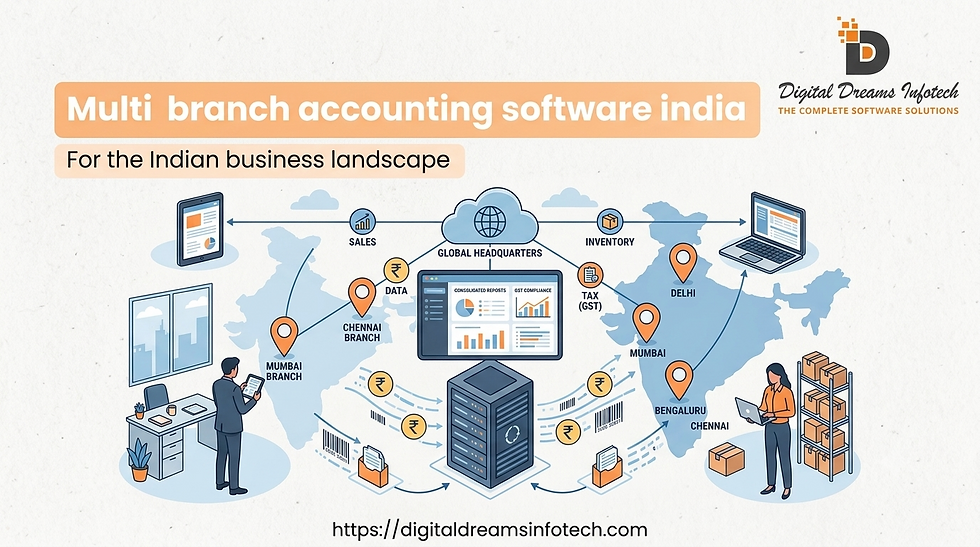
Many diamond and jewelry businesses operate across more than one location — a manufacturing unit plus a showroom, or multiple retail branches. The same multi-branch principles that apply to any growing SME apply here, with one addition specific to this trade: high-value stock movement between branches needs airtight documentation, both for internal control and because it's exactly the kind of movement that draws scrutiny if records are incomplete.
ERP software for this industry should give you centralized inventory visibility across every branch and manufacturing unit — showing what's in the showroom, what's with karigars, and what's in the vault — from a single dashboard, rather than requiring a phone call to each location to get an honest stock picture.
What to Look for Before You Switch
If you're currently managing a diamond or jewelry business on generic accounting software, spreadsheets, or a patchwork of separate tools, here's what actually matters in a switch:
Does it track stock by weight and purity, not just quantity?
Can it handle individual stone-level tracking with grading/certification data attached?
Does it support job-work transactions as a distinct type, with wastage tracking?
Can it split making charges from material value correctly on invoices for GST purposes?
Does it handle old gold exchange as a proper accounting transaction, not a manual workaround?
Can it give you multi-branch visibility if you operate more than one location?
Frequently Asked Questions
What makes diamond and jewelry ERP software different from regular accounting software?
Diamond and jewelry ERP software tracks stock by weight, purity, and individual stone characteristics (cut, colour, clarity, carat) rather than treating inventory as generic units at a fixed price. It also handles job-work movement with karigars, old gold exchange, and the specific GST treatment of making charges versus material value — none of which generic accounting software is built to manage accurately.
How is GST calculated on jewelry making charges?
GST on jewelry generally applies to both the material value and the making charges, though the applicable rate and treatment can depend on how the transaction is structured. Because this directly affects the final invoice amount and your GST filing, billing software needs to split material value and making charges clearly on every invoice rather than combining them into one line.
What is HUID and why does it matter for jewelry billing software?
HUID (Hallmark Unique ID) is a unique identification number assigned to hallmarked gold jewelry in India, mandatory for jewellers above the prescribed turnover threshold. Billing software needs to capture and print the HUID against each piece sold, tied to the actual inventory record, so it appears correctly on the customer invoice.
How does job-work accounting work for diamond and jewelry manufacturing?
When material is sent to a karigar for casting, setting, or polishing, it remains part of your inventory even though it's physically elsewhere. Proper job-work tracking records what was sent, to whom, and what's expected back — including any wastage — so your stock records stay accurate and job-work charges can be accounted for separately from material cost.
Can ERP software track individual diamonds by their grading certificate?
Yes — diamond and jewelry ERP software built for this industry can attach certification details (cut, colour, clarity, carat, and certifying lab) directly to each stone's inventory record, so grading information travels with the stock from purchase through to sale, rather than being tracked in a separate paper file.
Managing diamond stock, karigar job-work, or multi-branch jewelry operations? PlusERP by Digital Dreams Infotech is built for Surat's diamond and jewelry businesses — with weight and purity-based stock tracking, job-work management, GST-compliant billing with HUID support, and multi-branch visibility in one system. Book a free demo to see how it fits your specific operation.


Comments